

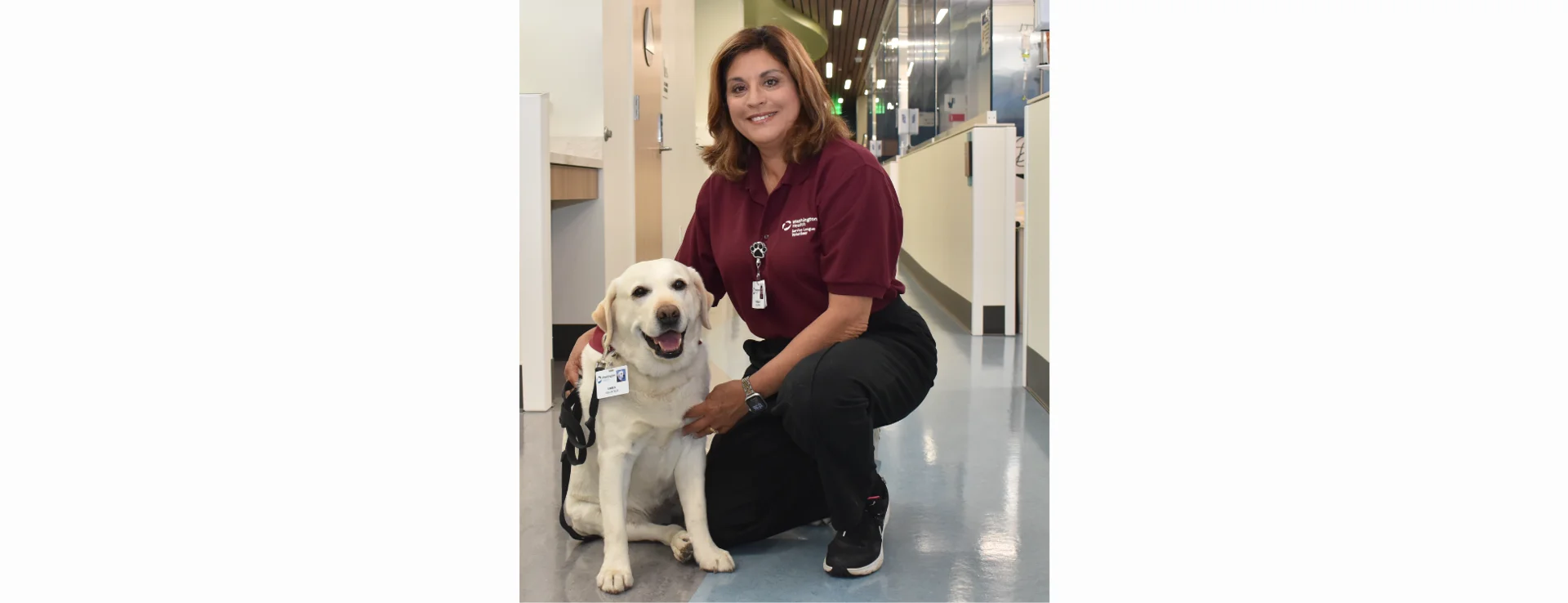
Washington Health’s pet therapy program continues to gain popularity, bringing happiness and healing to patients in the hospital or recovering at home.
In its sixth year, Washington Outreach of Fur (WOOF) has almost doubled in size over the past year, according to Jill Ziman, president of the Service League at Washington Health.
“The WOOF program is doing very well,” she says. With more than a dozen dog-handler teams this year, up from 10 in 2025, the WOOF program is very popular with patients.
“All the dogs I have met are incredibly kind and friendly,” notes Ziman. Each dog and their handler are evaluated by the WOOF program before being accepted and trained.
“Unconditional love from our four-legged volunteers is appreciated by both our staff and patients. Our WOOF dog team brings happiness to all they encounter,” says Evangeline Imana-Iyemura, director, Volunteer Services.
Research shows that pet therapy can lower stress hormones, reduce heart rate and blood pressure, and boost endorphins and oxytocin to promote relaxation, happiness and healing. Pet Partners, the international organization providing guidance to hospital pet therapy programs and animal certification, publishes supporting evidence (Chastain Griffin, 2020).
Health Benefits
Pet therapy has been shown to:
- Decrease perception of pain.
- Improve recovery rates.
- Cut anxiety and stress.
- Lessen fear and worry.
- Discourage biobehavioral markers of stress.
Teams of dogs and handlers get patient requests for a visit and can pop into a room to say a quick hello or stay longer. "This is just what I needed today,” shares one patient, “a white dog instead of a white coat."
“The WOOF program gives patients a chance to experience a friendly face and a chance to escape from maybe something difficult,” adds dog handler Terri Peters, who has volunteered with her dog, Ember, for approximately three years. “WOOF has given me a chance to give back to the community that I grew up in. I was born at Washington Health,” she says with a smile.
Washington Health gets more than 1,500 requests for patient pet visits a year. When admitted, patients are asked if they would like to see a WOOF dog.
“Most people are kind and want to do great things with their dogs,” explains Ziman. “It’s an amazing way to give back. If you have a furry friend that meets the requirements, it’s a great way to make a person feel better.”
Any breed can participate in the program but must be obedient, friendly, and in-tune with their handler. Dogs must be up to date on vaccinations, annual veterinarian exams and tests, in addition to being certified. Handlers and owners must be at least 18 years old, and dogs at least 1 year old. Volunteers are asked to commit to two 90-minute shifts per month.
Dogs Bring Smiles to Patients
“The outpouring of support makes me feel proud that WOOF is doing so well,” says Ziman. “Anything we can do to make our patients feel better and have a good day I’m all for. Being in the hospital is no fun and an animal can bring a smile.”
The WOOF program started under the leadership of former hospital CEO Nancy Farber, who enthusiastically supported the program during two years of vigorous planning and vetting. She volunteered with her Newfoundland Calypso before he passed away.
Ziman, a former dog owner, fondly remembers her 85-pound German Shepherd-Lab mix. “Dogs are so healing. Having had a dog, I know they feel your moods, react to you, and have a calming presence. They’re there for you and don’t ask anything in return. Whenever I was sick, my dog would always be there for me.”
For more information about volunteering with your dog, contact WOOF@washingtonhealth.com.
References
Chastain Griffin, T. (2020). Empirical support for therapy animal interventions [White paper]. Pet Partners. https://petpartners.org/publications/empirical-support-therapy-animal-interventions/