

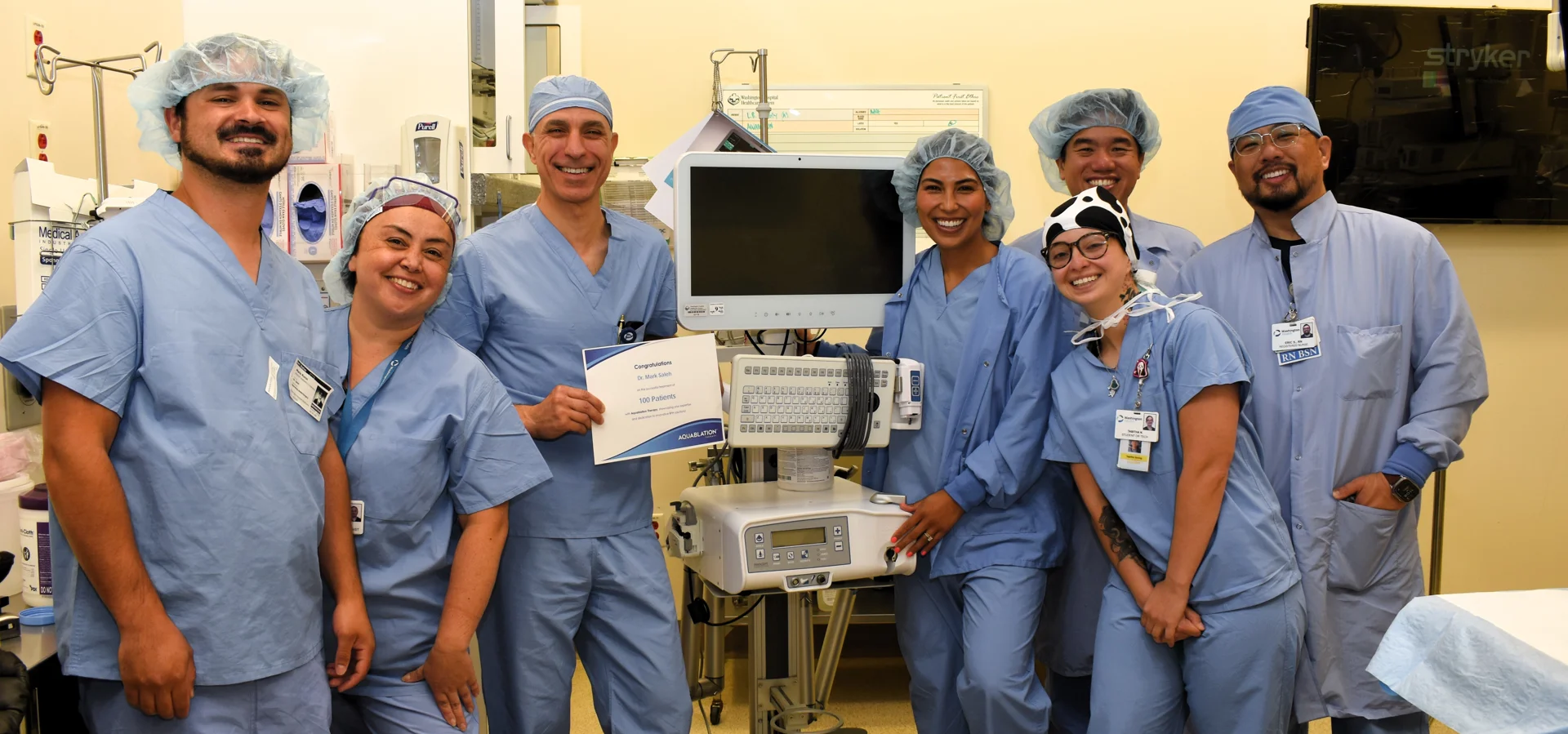
One of the few Bay Area urologists to offer Aquablation is celebrating a milestone that represents improved urinary function and quality of life for men throughout the community.
Although it affects many men, benign prostatic hyperplasia, or BPH, is rarely a topic of everyday conversation. Commonly called an enlarged prostate, BPH becomes increasingly prevalent with age.
BPH is often accompanied by urinary symptoms, which can develop as the bladder, prostate and urethra change with age. For many men, the symptoms develop gradually and become so familiar that they are simply accepted as part of getting older. They may include waking several times during the night to urinate, constantly searching for the nearest bathroom, waiting for a weak stream to begin, or never feeling as though the bladder has completely emptied.
The standard surgical treatment for BPH over several decades has been TURP, or transurethral resection of the prostate. TURP uses instruments inserted through the urethra to remove prostate tissue that blocks the flow of urine. A newer technology called Aquablation is providing another option that research suggests can deliver relief from urinary symptoms while reducing the likelihood of sexual side effects associated with traditional prostate surgery.
For Mark Saleh, MD, a board-certified urologist with Washington Health who has performed BPH surgeries for nearly 30 years, bringing Aquablation to the community was an important step forward in treating men with enlarged prostates. Dr. Saleh championed the effort to bring the Aquabeam Robotic System to Washington Health in 2023. This first FDA-approved Aquablation device uses waterjet technology to provide long-lasting urinary symptom relief, with low rates of complications across a range of prostate sizes and shapes. Now, Dr. Saleh is celebrating another milestone: his 100th Aquablation procedure.
“It has been fulfilling to bring this advanced robotic technology to Washington Health and offer another minimally invasive treatment option for men experiencing the effects of an enlarged prostate,” said Dr. Saleh. “For appropriate patients, Aquablation can provide meaningful relief from urinary symptoms, while offering an alternative to long-term medication or more traditional surgical approaches.”
The Aquablation Advantage
The benefits of Aquablation have been demonstrated in long-term clinical research. A five-year clinical trial published by the Canadian Journal of Urology compared Aquablation with TURP and found sustained symptom improvement and lower rates of complications with Aquablation, including ejaculatory dysfunction. A follow-up study among men with larger prostates measuring 50 to 80 mL, symptom improvement was greater with Aquablation, while the risk of requiring additional BPH treatment over five years, such as BPH medication or surgical intervention, was 51% lower in the Aquablation group.
“Aquablation is guided by continuous ultrasound monitoring, so I can visualize the prostate anatomy in real time during the procedure, which is a major benefit over TURP,” said Dr. Saleh. “This improved imaging enables me to see, and therefore protect, anatomical structures around the prostate.”
The technology can also make recovery easier for many patients. Since beginning to perform Aquablation three years ago, Dr. Saleh says the majority of his patients have been able to return home the same day.
“Traditionally, prostate resection patients were admitted to the hospital for overnight observation,” he explained. “But now, Aquablation is usually an outpatient procedure. Removing prostate tissue with water instead of heat eliminates thermal injury to surrounding tissue. This generally results in less bleeding after the procedure and, for some patients, less need for prolonged irrigation to clear blood and clots from the bladder.”
Improving Everyday Life
For Dr. Saleh, the significance of reaching 100 procedures goes beyond the number itself. It represents the difference the technology has made in the everyday lives of his patients. Some of the most memorable cases date back to the beginning of Washington Health’s Aquablation Program.
“We had some patients who relied on a Foley catheter to drain their bladder,” said Dr. Saleh. “TURP surgery was too complex and risky for them due to the large size of their prostates; however, these men were excellent candidates for Aquablation. Following the procedure, they no longer needed the catheter and were able to urinate naturally again, which greatly improved their quality of life.”
Today, men from throughout Northern California come to Washington Health for Aquablation. For Dr. Saleh, the 100th procedure is also a glimpse of where urological care is headed. He expects the technology to continue evolving and potentially be approved for more indications with other urological conditions and diseases. For the hundreds of thousands of men living with BPH-related symptoms today, advances such as Aquablation may offer something particularly valuable – the opportunity to restore urinary function and get back to living life with less disruption.
To learn more about Dr. Saleh or Washington Health’s urological services, visit washingtonhospital.com/urology.