

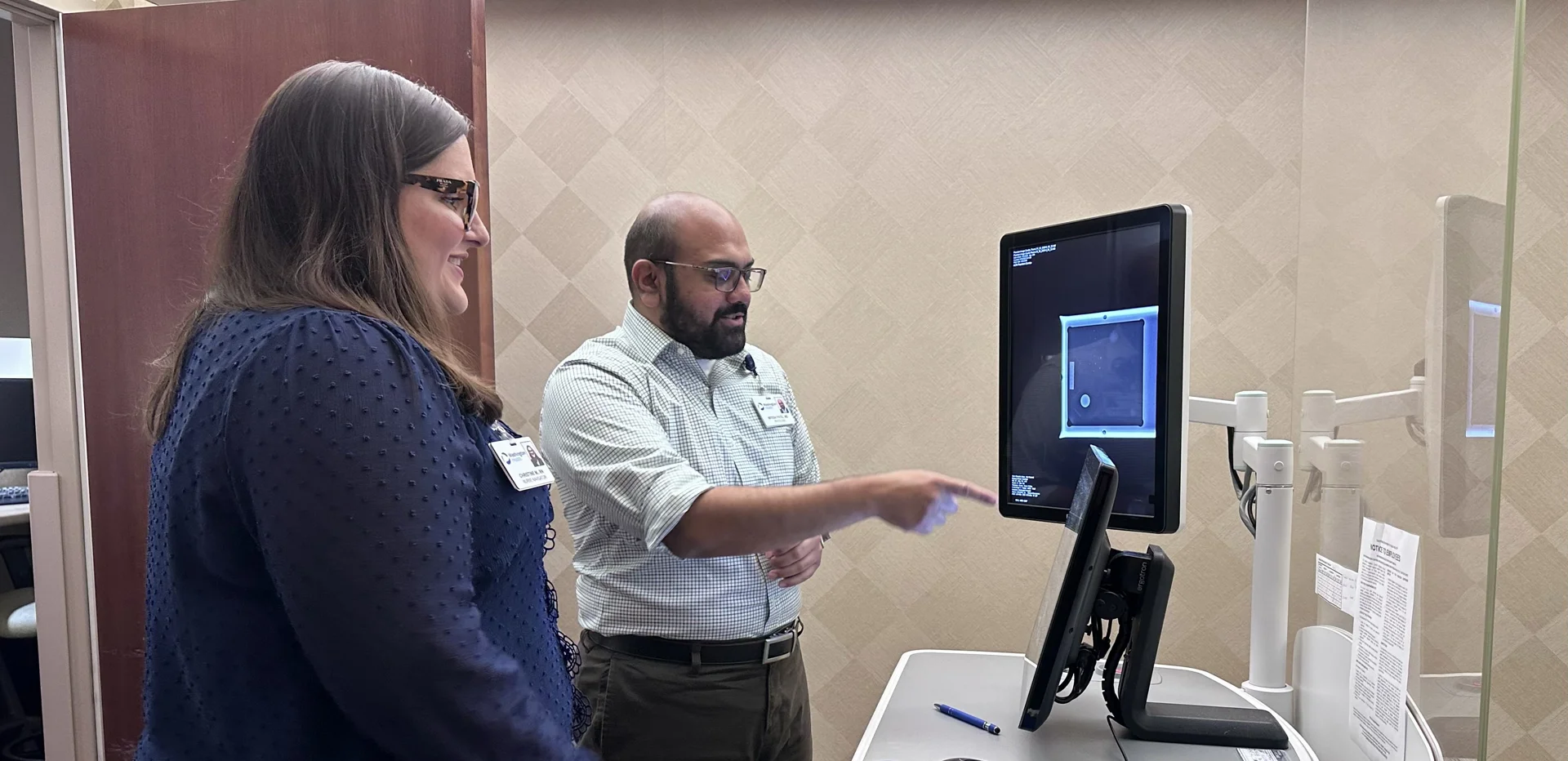
What to expect from your first appointment through imaging, biopsy and follow-up
You found a lump during a breast self-exam. Maybe you felt it while taking off your bra. Maybe your partner noticed it first.
However it happened, now you know it’s there. And the first thought is probably: Is it cancer?
“Even though it’s alarming, the first thought shouldn’t be cancer,” explained Washington Women’s Center Clinical Coordinator and Nurse Navigator Christine Mikkelsen, BSN, RN. “Breast lumps are common, and more often than not, it’s a benign finding.”
That doesn’t mean you should ignore a lump. It means you shouldn’t panic, either.
The first step
Mikkelsen’s advice is straightforward: Make an appointment with your physician and have the lump evaluated.
A physician will perform a clinical breast exam, ask about family history, and consider previous mammograms and other risk factors. For a new lump or other breast symptom, the next step may be diagnostic imaging rather than routine screening.
A diagnostic mammogram uses additional views to focus on the area of concern. An ultrasound may also be performed. Together, the imaging studies help the radiologist determine what comes next.
Washington Women’s Center has been designated a Breast Imaging Center of Excellence by the American College of Radiology each year since 2012. The designation recognizes centers accredited in mammography, stereotactic breast biopsy and breast ultrasound, including ultrasound-guided biopsy.
Sometimes the finding is normal breast tissue or a benign condition such as a cyst. In other cases, imaging may show an area that needs to be watched over time. And sometimes, a biopsy is recommended.
When a biopsy is needed
A breast biopsy provides tissue or cells that can be examined by a pathologist to determine whether cancer is present.
“At that diagnostic imaging appointment, they meet with us and the radiologist in real time to discuss the results, the biopsy recommendations,” Mikkelsen shared. “Then the nurse navigator helps coordinate the biopsy, helps schedule, or is a point of contact for information and support.”
That support continues if cancer is found.
“We start from the very beginning, from getting that initial appointment for diagnostic imaging all the way through biopsy,” Mikkelsen noted. “And then if the pathology does come back positive, we will work alongside the patient to help them get in quickly with their breast cancer team here at Washington.”
For Mikkelsen, the Women’s Center remains a resource regardless of the outcome.
“No matter what direction you go, we are always here as your resource, your support,” she said. “We’re here to help navigate.”
Know what is normal for you
Breast cancer can occur at any age, and Mikkelsen encourages women to know what is normal for their breasts and pay attention to changes.
Most importantly, she doesn’t want women to assume that finding a lump means they have cancer or avoid getting it checked because they are afraid of what they might find.
“We empower our community with this level of education,” Mikkelsen emphasized. “Know the next step.”
Washington Health will present the podcast “I Found a Lump. Now What?” featuring Mikkelsen and Emily Gentry, PA-C, on Oct. 8 on their YouTube channel.
To learn more about breast care at Washington Health, visit washingtonhealth.com/WomensCenter.
Think Pink returns Oct. 15
Free community event offers breast health information, resources and support
Washington Health will host its 18th annual Think Pink event Thursday, Oct. 15, from 5 to 7 p.m. at the Tent Atrium at Washington West.
The free event is open to the community, and no registration is required. The first hour will feature a health fair with Washington Health departments and community organizations offering breast health information and resources. A boxed dinner will be provided.
The second hour will feature presentations on breast cancer care and survivorship, including treatment options and breast reconstruction.
Speakers include Victoria Leiphart, MD, FACOG, gynecologist; William Dugoni Jr., MD, general surgeon and director of Washington Women’s Center; Alissa Erogbogbo, MD, OB-GYN and chief of Women’s Health Services at Washington Health; and Prasad Kilaru, MD, plastic surgeon and director of Washington Center for Wound Healing & Hyperbaric Medicine.
“Think Pink is not just for cancer patients, it’s for the community,” Mikkelsen said.
To view upcoming Washington Health events and classes, visit washingtonhealth.com/events.