

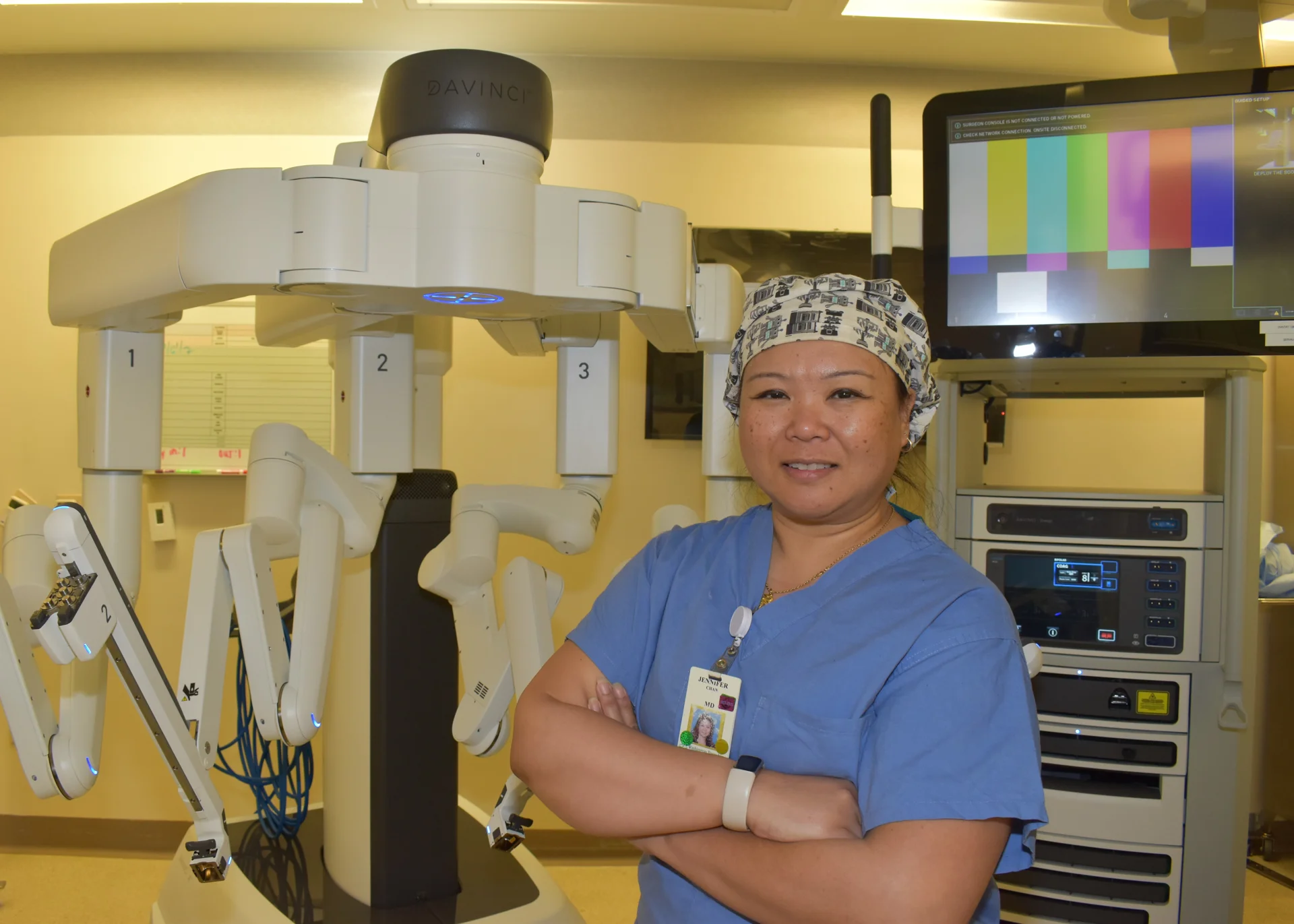
Lung cancer is the leading cause of cancer deaths in the United States, claiming more lives each year than breast, colon, and prostate cancers combined. Tri-City residents now have access to advanced lung cancer technology with two groundbreaking robotic platforms at Washington Health: the Ion endoluminal system (lung cancer biopsy robot) and the da Vinci Xi robotic surgical system. Together, these technologies are transforming how lung cancer is diagnosed and removed, often before it has a chance to spread.
Robotic-Assisted Lung Nodule Biopsy and Removal
Washington Health’s Ion robotic-assisted bronchoscopy platform allows thoracic surgeons to navigate deep into the lungs with remarkable precision using a minimally invasive approach. Through a tiny flexible catheter guided by advanced imaging technology, surgeons can reach small or hard-to-access lung nodules and obtain biopsies earlier and more accurately than ever before. This is especially important because suspicious lung nodules are often discovered incidentally during chest X-rays or CT scans. The Ion system helps shorten the traditional lung cancer diagnosis timeline of invasive procedures and time-consuming referrals. It can help give patients answers sooner and allow treatment to begin earlier if cancer is detected.
“Before the Ion system, providing patients with an early, definitive diagnosis was challenging because once a suspect nodule was identified, it was often too small or difficult to reach bronchoscopically,” said Jennifer O. Chan, MD, a double board-certified thoracic and general surgeon at Washington Health. “Ion enables us to navigate directly to the nodule through a minimally invasive approach, with a lower chance of collapsed lung during biopsy, and the ability to inject a dye to help identify the tumor during surgery. This allows us to remove less lung tissue and complete both diagnosis and surgical resection all in one single procedure.”
Once Dr. Chan locates, biopsies, and dyes the nodule with the Ion system, she can then use the da Vinci robotic surgical system to remove cancerous tumors through minimally invasive surgery using tiny incisions and robotic instruments. The system provides surgeons enhanced visualization, precision, and dexterity during complex procedures. For patients, that usually means less pain, smaller scars, shorter hospital stays, and faster recovery times compared to traditional open chest surgery.
Washington Health’s robot-assisted surgical technology was made possible through the generosity of community donors whose philanthropic support at the 2025 Top Hat Gala helped fund the Ion and da Vinci robotic systems.
Lung Cancer Diagnosis Dilemma
Though stage 1 lung cancer is associated with the highest survival rate, these cancers are rarely diagnosed early. Lung cancer causes few or no noticeable signs in its early stages, other than symptoms that mimic minor respiratory illnesses. By the time individuals experience persistent coughing, chest pain, or shortness of breath, the cancer has often spread to other parts of the body, limiting treatment options.
Unlike breast or colon cancer, which have routine screening protocols that catch cancers before they spread, insurance and Medicare in the U.S. only covers lung cancer screening for those who currently smoke heavily or have quit within the past 15 years, along with other strict criteria. However, according to the CDC, up to 20% of new lung cancer cases are found in people who have never smoked. Unfortunately, these patients are not getting screened unless they pay out-of-pocket for costly imaging or travel out of the country for affordable cash-pay screenings.
“Early detection and timely treatment are critical, but for many patients, accessing advanced care has traditionally meant traveling across the Bay Area to major academic medical centers. By working very closely with our team of excellent pulmonologists and UCSF – Washington Cancer Center oncologists, paired with the combination of robotic bronchoscopy and robotic surgery, we provide patients with a seamless approach to lung cancer from early detection to diagnosis, treatment, and recovery. For our patients, that means hope, access, and lifesaving lung cancer care right in their community,” added Dr. Chan.
This is part one of a two-part series on Washington Health’s lung cancer surgical robotic systems. See this page in next week’s Tri-City Voice to read a Fremont lung cancer patient’s success story. To learn more about Dr. Chan, go to www.washingtonhealth.com/find-your-physician/jennifer-olivia-chan-md/. For information on the newly expanded UCSF – Washington Cancer Center that opened in January, go to www.washingtonhealth.com/services/oncology/