

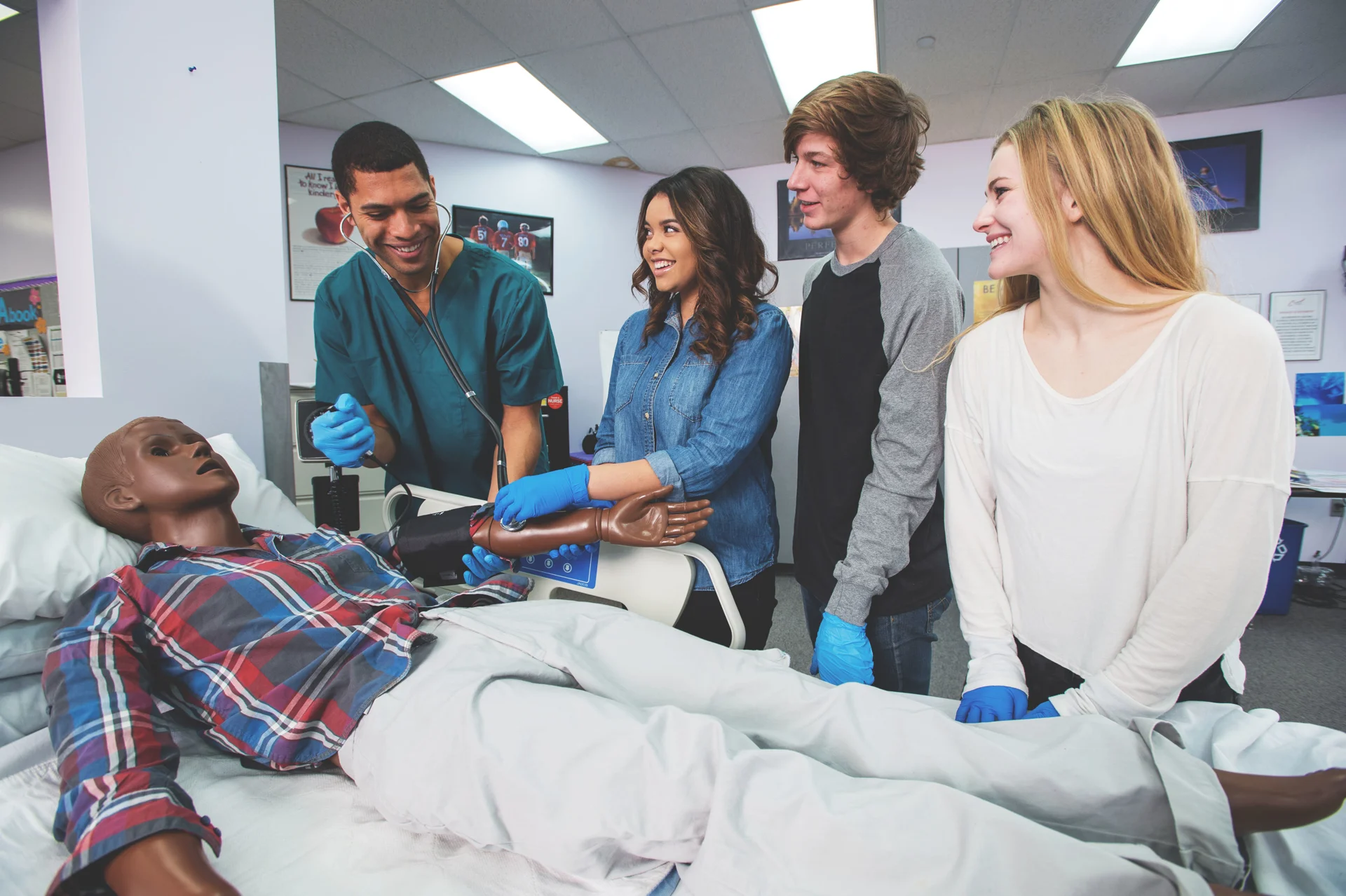
For a high school student thinking about a career in health care, “doctor” or “nurse” may be the only possibilities that come to mind.
Washington Health’s Medical Explorer Post 539 is designed to expand that vision.
For more than 40 years, the program has given young people in the Washington Township Health Care District community opportunities to explore health care careers firsthand. Students hear from physicians and other health care professionals, tour hospital departments, participate in hands-on activities and simulations, develop leadership skills and learn about the many career paths available in health care.
Kristin Ferguson, MSN, MHA, BS, RN, CHC, Washington Health vice president and chief compliance and risk officer, has served as the program’s adult administrator for more than 15 years. Her involvement began when the leadership role was passed to her by the previous chief compliance officer.
For Ferguson, one of the most rewarding parts of the program is watching students discover just how many possibilities exist within health care.
“We have a lot of really young, smart, intelligent and very driven high school students in our area,” Ferguson said. “Lots of them have interests in various careers in health care, and so this program gives them an opportunity to have some insight into the day in the life and the educational path of different professions.”
The program deliberately looks beyond the traditional image of health care. Students may hear from professionals in pharmacy, physical and occupational therapy, dietetics, health care information technology, finance and biotechnology, as well as physicians and nurses. That exposure can be particularly valuable for students who arrive believing that becoming a physician is their only choice.
“Being a doctor is not the only job in health care,” Ferguson explained. “If you’re techy, you can be a tech person, and work in health care. There are all kinds of options, and they get very excited about all the possibilities within health care.”
Hands-on learning
The program gives students something that cannot be learned from a textbook: direct contact with people doing the work.
Explorers have opportunities to tour hospital departments and participate in hands-on experiences, including anatomy activities, catheterization laboratory tours and birthing simulations. They can ask questions, learn about educational paths and get a glimpse of what life in a particular career is really like.
“It really gives them an opportunity to meet people, to ask questions and really help them kind of ground their plan,” Ferguson said.
Meetings use a hybrid format, with some held in person and others over Zoom. Safety remains a priority, with students following established virtual meeting protocols and Boy Scouts of America guidelines.
The lessons also extend beyond choosing a career.
Speakers encourage students to become well-rounded individuals, rather than focusing exclusively on science courses and grades. They talk about managing stress, maintaining balance and finding interests outside the classroom.
“Study hard but find time to have some fun and find a way to have an outlet to release the stress,” Ferguson advised. “Speakers give the students some additional insights into how to sustain and survive through the years of school and challenging careers.”
The Medical Explorers Program also provides opportunities to practice leadership and communication skills. Students elect officers each year, participate in planning and learn to speak comfortably in front of their peers.
The program incorporates community service, too. Each Christmas, students create gift baskets and bags for children served by local family shelters and other programs.
“We always do a community project as well, where they have to give back to the community,” Ferguson said. “We give them snacks every month, and then the last program of the year in May we always do a big pizza party.”
Building for the future
Perhaps the most meaningful part comes later, when students report back about where their exploration has taken them.
Ferguson said it is particularly rewarding to hear from students who have chosen a career path or been accepted into college, nursing school or medical school.
She also sees her own career, moving from bedside nursing to executive leadership, as an example of how a health care career can evolve.
“You can stay on a clinical path, or you could take your experience as I did and move up the ladder and do all kinds of things,” Ferguson shared. “Physicians can become CMIOs. They can become quality officers, safety officers, chief of staff or chief medical officer. You can even become the hospital CEO.”
For students trying to imagine their futures, those stories can be powerful.
“They’re looking for mentors,” Ferguson said. “They’re looking for other things to inspire them.”
Sometimes, what a young person needs most is to hear from someone who has already traveled a path that’s similar to theirs. “They may realize, maybe that dream I’m thinking about isn’t unreasonable,” she said. “They can do it because this person just did it, too.”
Medical Explorers Post 539 meets on the fourth Thursday of every month from 6 to 7 p.m. and will host an open house Thursday, Oct. 1, at 6 p.m. in the Anderson Auditorium. The first meeting is free, giving students an opportunity to learn about the program. After that, annual membership is $50. Students can apply online at my.scouting.org.
For more information about Washington Health Medical Explorers, including applications, dues, meeting activities and location, visit Post 539 on Facebook at facebook.com/MedEx.Post539.