

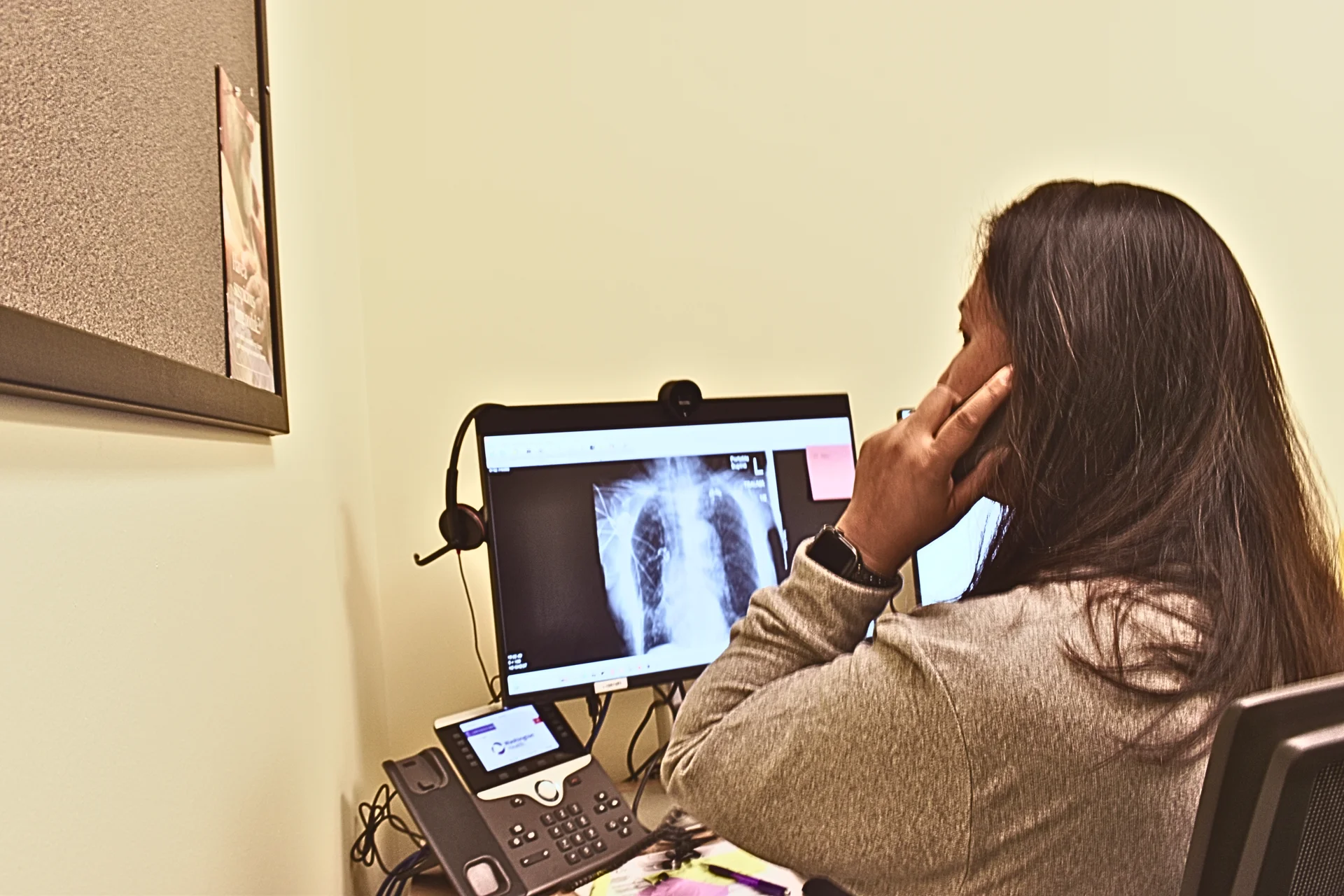
Washington Health low-dose CT screening can detect lung cancer before symptoms appear
In this hypothetical scenario, Tony’s parents started smoking in high school in the 1950s. He followed suit in the 1970s. By 2020, Tony had been smoking for 40 years and trying to quit for more than a decade. He finally talked with his primary care provider, who helped him find the tools he needed to quit for good and referred him for low-dose CT lung cancer screening.
The scan is quick and painless. For people at high risk of lung cancer because of their smoking history, it offers an opportunity to find cancer before symptoms develop, when treatment may be more effective. Yet low-dose CT lung cancer screening remains underused, even among people who qualify.
“Unfortunately, I think we only screen really less than 15% of all patients that are eligible,” said Dr. Jennifer Chan, a thoracic surgeon at Washington Health. “Many lung cancers are discovered through incidental findings on imaging performed for other reasons rather than through dedicated screening.”
Who should be screened?
The American Cancer Society recommends annual low-dose CT lung cancer screening for adults ages 50 to 80 who have no symptoms, currently smoke or formerly smoked, and have a smoking history of at least 20 pack-years. A pack-year equals smoking one pack of cigarettes a day for one year; someone who smoked two packs a day for 10 years would also have a 20-pack-year history.
The test uses less radiation than a standard CT scan to create detailed images of the lungs without an invasive procedure. Medicare and many commercial insurance plans cover screening for eligible patients, although coverage requirements can differ from the American Cancer Society’s recommendations.
A nodule doesn't automatically mean cancer
One concern that can keep people from getting screened is fear of what the scan might find. But a lung nodule — a small spot or area of abnormal tissue — is not necessarily cancer.
More than 95% of lung nodules are benign, according to the American Thoracic Society. Some are scars from previous infections or other inflammatory changes. Others may require additional imaging or testing to determine whether they are cancerous. Screening can also reveal other lung abnormalities, and CT images may identify findings outside the lungs that warrant further evaluation.
“Not all nodules are cancerous, but finding them gives us the chance to make sure,” Chan explained. “Finding lung cancer early also increases survival rates. For patients with nodules, the most important next step is ensuring that recommended follow-up happens promptly.”
Helping patients navigate the next steps
That is where Washington Health’s new Lung Nodule Program comes in. Affiliated with UCSF Health, the program is designed to track, evaluate, and manage pulmonary nodules identified through screening and other medical imaging.
Djohanna Ablao, BSN, RN, PHN, serves as thoracic nurse navigator for the program. She helps patients understand their results, coordinate appointments and testing, and determine whether a nodule needs continued monitoring or more immediate investigation.
“It’s us handholding them to the next step and helping them through this process,” Ablao said. “It’s a second pair of eyes, ears and hands for patients. The program adds another layer of support, helping patients move from a screening result to the right next step, whether that means reassurance, continued monitoring or a timely diagnosis.”
The program brings together thoracic surgery, pulmonology, radiology and primary care to streamline evaluation and reduce delays. Depending on the findings, a patient may need repeat imaging to monitor a nodule, additional diagnostic testing or a biopsy using the Intuitive Ion system.
Navigation does not end when a patient receives an initial recommendation. Some nodules require surveillance over time, and patients need to return for follow-up imaging to determine whether anything has changed. Ablao also helps patients navigate the practical challenges of referrals, insurance authorization and scheduling.
“We want to track changes and monitor for any growth,” Ablao said. “But in case there is growth, we’re ready because we’re keeping track of those patients as well.”
Don't wait for symptoms
For Chan, the goal is to identify lung cancer while patients still feel well and the disease may be treated more effectively.
“The entire point of screening is that you have no symptoms,” she pointed out. “Screening does not guarantee that cancer will be found, nor does a negative result eliminate future risk. That’s why eligible patients should continue annual screening and maintain communication with their healthcare providers. The potential benefit — finding a problem before symptoms develop — can be life-changing.”
The message is straightforward: If you have a history of smoking, don’t assume that feeling well means your lungs are healthy. Ask your healthcare provider whether you qualify for low-dose CT lung cancer screening. Early detection starts with that conversation.
To learn more about lung cancer screening at Washington Health, visit washingtonhealth.com/cancer.