

At Washington Health Foundation's milestone Top Hat Gala, a neurosurgeon's unexpected journey and decades of community generosity came together to shape the future of patient care.
Dr. Rajiv Saigal stood at the podium, his image projected onto a towering screen and his voice carrying across nearly 700 guests dressed in elegant gowns and tuxedos. Above them, hundreds of twinkling lights draped the branches of trees, casting a glow over a space that, on an ordinary day, was simply a hospital parking lot.
For Dr. Saigal, a neurosurgeon with Washington Health’s Bell Neuroscience Institute and an associate professor at UCSF whose life's work has centered on using technology to help patients with spinal cord injuries, the most striking transformation wasn't the setting. It was what the people gathered there were making possible. Attending Washington Health Foundation's 40th Top Hat Gala for the first time, he was struck by the outpouring of support for the hospital.
"It's awesome to see the whole community gathering together and see so many supporters of the hospital," he said.
Yet growing up in New Orleans, Dr. Saigal could hardly have imagined finding himself here — much less helping lead an evening dedicated to bringing new neurosurgical technology to the community. Neither of his parents was a doctor or an engineer. In fact, he didn't even know what an engineer was until high school.
What he did know was that he loved math and science. That curiosity led him to Georgia Tech, where he studied electrical engineering, and later to graduate studies in bioengineering. Along the way, he became fascinated by how technology could help people with spinal cord injuries, an interest that would shape his career.
Initially drawn to research, Dr. Saigal discovered another calling while taking medical school classes during his doctoral studies. Translating research discoveries into treatments could take a decade or longer. Surgery offered something different: a chance to help patients immediately while continuing to develop innovations for the future.
"The possibility of helping patients with their problems now," he explained, alongside developing new technologies and treatments, was what drew him to medicine. That intersection of technology and patient care was at the heart of the evening's fundraising mission.
Washington Health Foundation's sold-out gala raised more than $2 million in gross proceeds — the highest total in Top Hat history — toward a new robotic platform for neurosurgical care. The investment will expand the hospital's surgical capabilities, bringing specialized care closer to patients in the community.
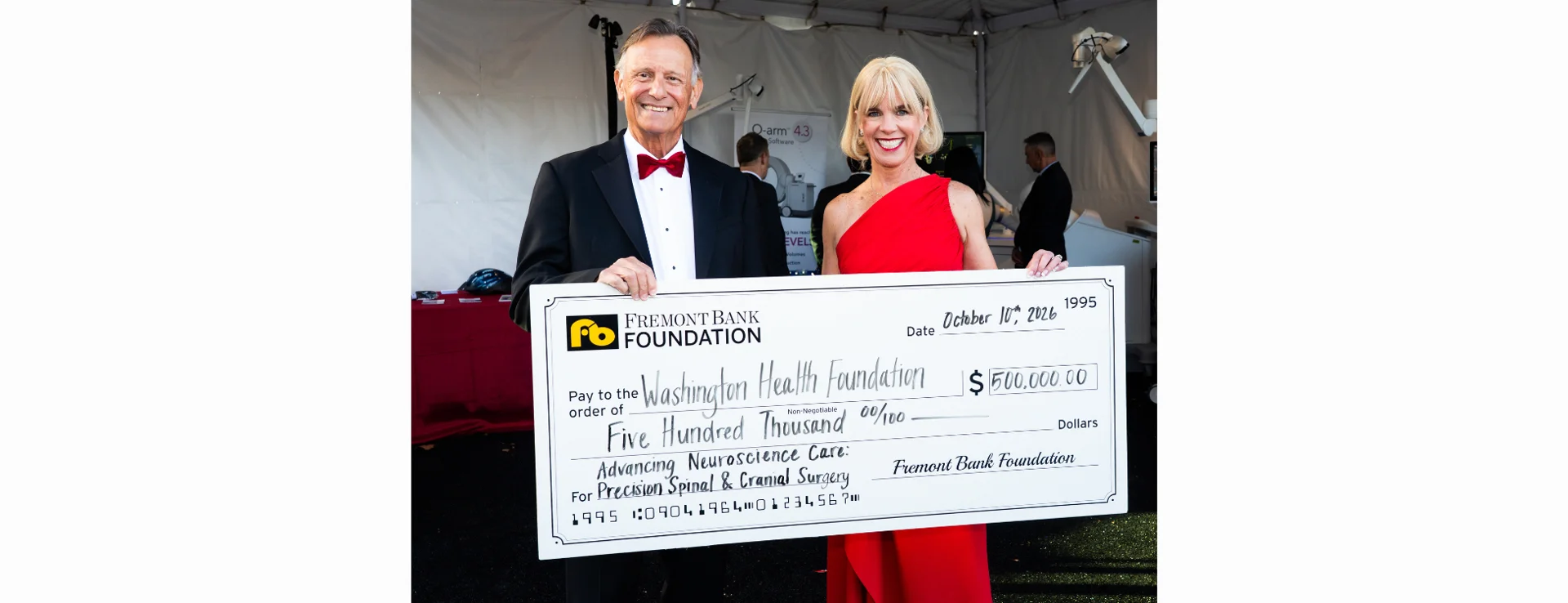
One of the evening's defining moments came when Mike Wallace, chairman of the Fremont Bank board and a member of Washington Township Health Care District Board of Directors, raised his paddle to announce a $500,000 gift from the Fremont Bank Foundation. For Sarah Gemski, executive director of Washington Health Foundation, the moment captured the spirit of Top Hat.
"It’s just remarkable to see what a room of 700 people can do when we all come together for a bigger purpose," she said.
But the record-breaking evening didn't happen overnight. It was built on 40 years of relationships — generations of donors, foundation trustees, committee members and volunteer leaders whose commitment to Washington Health has helped turn philanthropy into advances in patient care.
This year's gala, co-chaired by Dr. Saigal and Rod Silveira, a former president of Washington Health Foundation, continued that legacy with support from leading sponsors, including Fremont Bank, Audrey and Michael Kearns, and an anonymous donor. The results are already visible throughout Washington Health. Recent Top Hat fundraising has supported robotic bronchoscopy technology for lung care, MRI equipment and the UCSF-Washington Cancer Center.
For Dr. Saigal, the evening brought together two journeys: a four-decade commitment to improving local health care and his lifelong interest in using technology to help people with spinal cord injuries. Yet what makes Washington Health special to him isn't simply its technology. It's the relationships among its physicians, nurses, rehabilitation teams, leadership and, most importantly, patients.
"One thing that makes Washington Health stand out is that it feels like a family," Dr. Saigal said. "It's really easy to get to know people throughout the organization, from the CEO down to your physician colleagues to the nurses and rehab staff."
Dr. Saigal's journey began with curiosity about how technology could help others. At Washington Health, he found a team that shared his passion, backed by a community whose generosity continues to bring advanced care to patients in Fremont.
To support Washington Health Foundation and learn more about its work, visit washingtonhealth.com/donate.