

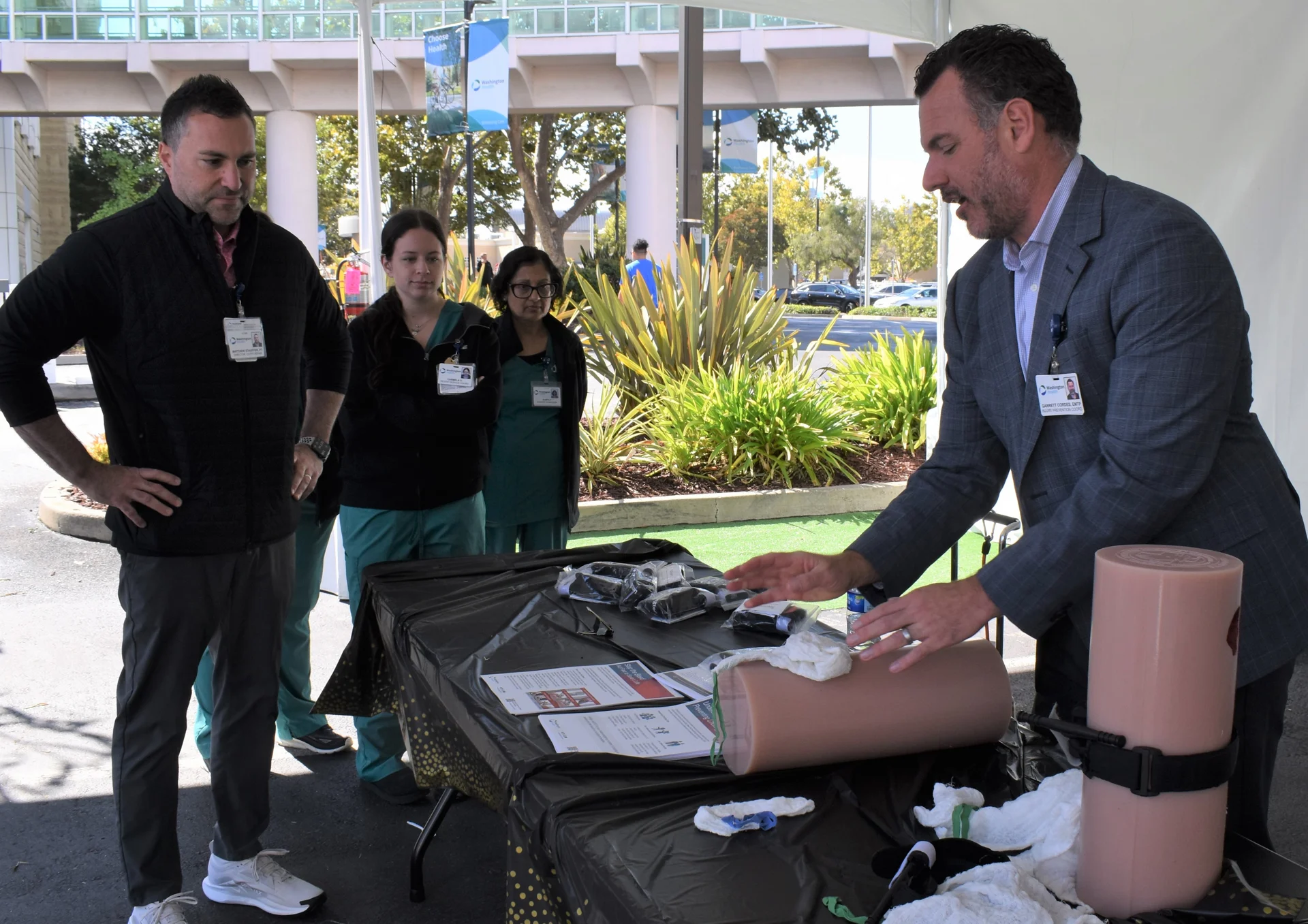
Would you know what to do if someone nearby has an injury that results in unchecked bleeding? Perhaps the person cut themselves while cooking with a heavy knife and severed an artery. Or fell into and broke a glass table and was bleeding profusely; or was seriously injured in an automobile accident. How could you help? What should you do?
Injuries that cause serious bleeds can happen anywhere, says Garrett Cordes, Washington Hospital’s Injury Prevention coordinator. “The important thing is to try to stop the bleeding immediately anyway you can — whether it’s putting pressure on a cut or stuffing a clean cloth into a deep wound. These actions can save lives while you are calling 911.”
Cordes will demonstrate simple, lifesaving steps to help control bleeding before 911 help arrives at a Saturday, June 10, Washington Health online seminar. The 10 a.m. program, “Stop the Bleed to Save a Life” can be viewed on YouTube at YouTube.com/@Washington_Health. For those who miss the live presentation, the video will be added to the Washington Health video library. This library of health-related topics features health care experts.
The goal of the seminar is to give people confidence to act at a time when every second counts. The seminar will include demonstrations of the steps one can take to stem uncontrolled bleeding. “It’s easy to be scared that what you do might not be correct,” he says. “Any action that starts to control the bleeding can help; the goal is to act, not hesitate. You’re buying time until help arrives.”
Cordes adds: “Bleeding incidents can occur anywhere: at home, a car accident, at a construction site or even a senior center. Wherever you are, it’s essential to act. Call 911 and then:
- Pack a wad of cloth into the opening.
- Apply pressure on the cut.
- If the cut is an arm, hand, or foot, try to elevate the limb.
- Tie a tourniquet above the wound if possible. Note: tie it very tight. You are trying to cut off blood supply and will not likely cause further injury.
Don’t worry about having perfect medical supplies; do the best you can wherever you are with whatever is at hand. Hopefully, emergency responders will arrive soon.”
In addition to the June 10 online seminar, Cordes conducts, in-person Stop The Bleed classes for various community groups, businesses, and senior and civic organizations. These one-hour classes include demonstrations and hands-on practice activities, including how to correctly use a tourniquet. Participants receive a completion certificate and a free tourniquet at the end of the class. To date, classes have been held at local high schools, senior centers, the Tri-Valley Food Bank and violence intervention programs.
Learning how to stop uncontrolled bleeding is an essential emergency preparedness skill, along with other emergency techniques, such as knowing how to help someone who may be choking, or how to perform CPR to someone who is unresponsive. “Just knowing what to do and not be fearful when in an emergency situation,” stresses Cordes, “can save a life.”
For information on Washington Health’s Trauma Center, visit WashingtonHealth.com/Trauma. For those interested in classes offered, email Cordes at garrett_cordes@washingtonhealth.com.